
We found 76,450 real Gemini conversations.
These publicly shared conversations span almost two years of exchanges, from November 2024 to October 2026. We collected and analysed them to understand how Gemini uses the web to answer.
The shares retain more than the displayed dialogue: Google searches run by Gemini, cited pages and passages linked to its statements. This gave us 222,753 searches to study, tracing citations back to the questions that prompted them.
This exclusive investigation examines what happens between your question and the sources shown. We supplemented it with live tests of Google’s prompt classifier, which assigns categories to user requests.
Gemini assigns categories
to your question
During the response, Google sends the browser a score sheet about your question. It describes the topic, requested task, follow-up type and sentiment. The interface does not display it.
The sheet arrives within seconds: a median of 2.5 seconds across our 40 signed-out runs. Looking for shoes is both a shopping question and a request for a recommendation: each category receives its own score.
In the interface code, we found these scores being used to decide whether to display a satisfaction survey.
All 106 classifier categories
35 topics, 47 tasks, 22 follow-up types and 2 sentiment scores, with their original labels.
35 topics
- Academic - Other
- Coding
- Creative - Other
- Creative Writing
- Customer Support
- Daily Life Expert - Other
- Daily Life Personal - Other
- Data Analysis
- Emotional Support
- Engagement - Other
- Events
- Finance / Accounting
- Fitness
- Games
- General Info Seeking
- Government / Law
- HR / Career Management
- Health
- Life Organizer
- Lifelong Learning
- Marketing & Advertising
- Meals / Nutrition
- Media / Entertainment
- Multimodal Generation
- News / Status
- Personal Finance
- Professional - Other
- Sales / Order Fulfillment
- School Work
- Shopping
- Social / Roleplay
- Sports
- Teaching
- Travel
- Troubleshoot Issues
47 tasks
- Action Execution / Device Control - Other
- Advice & Opinion - Other
- Analyze Image Files
- Audio Generation
- Brainstorming
- Casual Interaction / Chat - Other
- Casual Topic Chat
- Classification
- Code - Other
- Code Debugging
- Code Explanation / QA
- Code Generation
- Compile
- Comprehension / QA
- Continue / Add More
- Device / App Control
- Find Image
- Game
- Image Edit
- Image Generation
- Image Understanding - Other
- Information Gathering - Other
- Mathematical Reasoning
- Media Execution
- Multimodal Generation - Other
- Perspective
- Procedural Instruction
- Proofreading / Grammar
- Quiz / Test
- Reasoning & Games - Other
- Recommendation
- Share Sentiment
- Simple Pleasantries
- Simple Search
- Subjective Rewrite / Revision
- Synthesize Broad Topic
- Task Planning
- Text Analysis - Other
- Text Extraction
- Text Summarization
- Translation - Other
- Translation, En to Non-En
- Translation, Non-En to En
- Video Generation
- Visual Referencing
- Writing & Rewriting - Other
- Writing From Scratch
22 follow-up types
- Output List
- Output Outline
- Output Table
- Output Citations
- Output Format
- Change Length
- Change Ordering
- Change Structure
- Adopt Persona
- Change Tone
- Rhyme
- Change to Specific Audience
- Change Tone / Style
- Rephrase
- Simplify / Condense
- Factual / Logical Correction
- Attribute-Specific Correction
- Pushback Circumvention
- Constraint Re-Statement
- Exact Resubmission
- Expand / Elaborate
- Revise
2 sentiment scores
- Positive
- Negative
What are the best running shoes for beginners?
35 topics
47 tasks
22 follow-up types
2 sentiment scores
Gemini expands your question
before searching
Gemini rewrites the question to search Google. One question can produce several queries: different wordings sent to the search engine. They may switch languages and add a year you did not mention.
Quelles chaussures choisir pour commencer à courir ?
Illustrative examplerunning shoes for beginnersrunning shoes for beginners 2026A French answer can therefore draw on pages found through English searches. Understanding the sources chosen requires looking at Gemini’s searches, beyond the words typed by the user.
Other common rewrites
beginner running shoes cushioning stabilityBrooks Ghost 17 cushioning for beginnersbeginner running shoes FranceAsics vs Brooks running shoes for beginnersbeginner running shoes reviews redditFrom four searches to two per exchange
Monthly trends · January to October 2026. English searches and added years also vary over time.
Number of searches
Use of English
Added year
A third of cited passages
start in the first tenth of the text
The very beginning already accounts for a third of selected passages. Expanding to the first half of the text covers four out of five.
In a 1,000-word article, the first 10% means the first 100 words. This refers to the content text, not screen height or site menus.
In your content, present the answer and supporting facts early. Readers should be able to find them without working through a long introduction.
1,454 passages located on 900 pages.
in the first 10% of the text
including the first tenth
Wikipedia and news sites lead the citations,
YouTube is read but rarely cited
Nearly one sourced answer in three cites Wikipedia, in 2025 as in 2026. News sites are gaining ground: in 2026, 55 sourced answers out of 100 cite at least one news site, against 41 in 2025. Reddit, almost absent in 2025, has been cited in 5 answers out of 100 since February 2026. Health and research sites decline sharply.
Share of sourced answers citing each site
Types of sites cited
Out of 100 sourced answers, how many cite at least one site of each type
Being read is not enough
A Wikipedia page consulted by Gemini is cited a little less than one time in two, a Reddit page a little more than one time in three, a page from other sites three times in ten. YouTube appears among the consulted pages in nearly one answer in five, but a consulted video is cited only one time in five.
YouTube appears among the consulted pages in 18% of answers, but is cited in only 5%.
For your content: the first step is to be among the pages Gemini consults. After that, a page that states the facts clearly in writing is more likely to be cited.
Share of consulted pages that get cited
Citations also reach
beyond the largest sites
of sourced answers cite at least one site beyond the one-million global rank or absent from the ranking.
An answer can combine a large site with sources that are less popular worldwide.
Popularity: NicheObserver Reach (Chrome UX Report data). 16,221 sourced answers.
Gemini can search
without displaying sources
An answer with no citation may still draw on a Google search. Since May 2026, this applies to 43% of searched exchanges in the corpus.
11 May to 12 October 2026 · 7,277 searched exchanges.
Searches without citations fell until May, then levelled off around 40%
Share of answers with a Google search that show no citation · January to October 2026
The cited passage aligns most closely
with the answer sentence
For each citation studied, we compared the passages within a page with the Gemini sentence, then with the associated Google search. The cited passage is more often the one whose words most closely match the answer sentence.
When starting out, choose comfortable shoes suited to your feet and the terrain. 1
For your first runs, comfort and fit matter. Choose a shoe suited to the terrain you will be running on.
Word-based comparison across 1,807 citations. A page has a median of 68 passages: picking one at random would land on the cited passage in 2% of cases. The bars measure two separate comparisons and are not additive.
Half of the passages contain 43 words or fewer.
99% of displayed excerpts reproduce the start of the passage.
Gemini also rephrases what it cites: 70% of the answer sentences studied share no sequence of four words with the source passage. A citation can therefore support the same idea in different words.
Explore a conversation here
Paste a Gemini share link or choose an example: its searches, pages and passages appear below.
Accepted links: share.gemini.google/…, gemini.google.com/share/…, g.co/gemini/share/… or the bare identifier.
 Our Chrome extension
See Gemini’s searches
in your own conversations
Search & fan-out capture, our ChatGPT plugin, now supports Gemini. See its Google queries, consulted and cited pages, passages linked to answers, and prompt classifier scores.
Bring your captures together in a dashboard and export the data as CSV or JSON for your own analysis.
Explore and install the plugin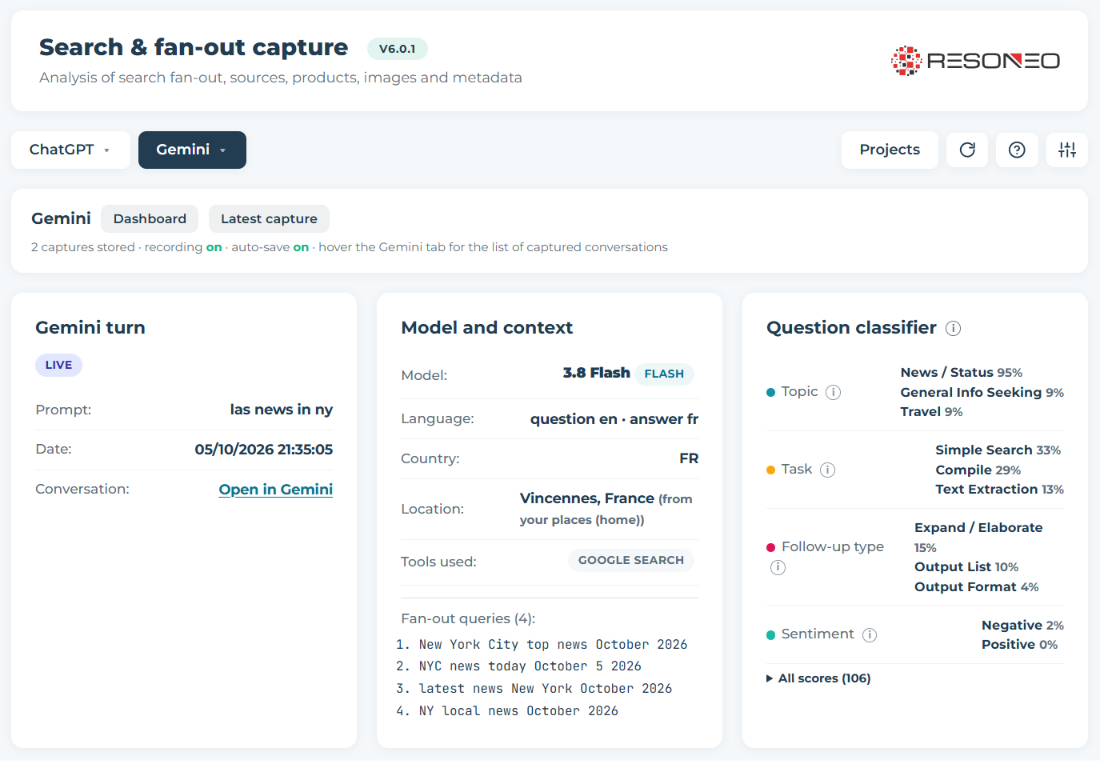
Method and data access
We found 76,450 publicly shared Gemini conversations, from November 2024 to October 2026. Some contain personal information and were not intended to be seen by everyone. We do not disclose how we found them.
The dataset is available on request to researchers wishing to extend the analysis. Contact me on LinkedIn or X.
Data and calculations
One share is retained per conversation: the longest. Links still accessible were re-read on 2 and 3 October 2026, then on 14 October for more recent shares, without an account. Results describe this corpus and the traces retained by the web interface.
- Searches
- 222,753 queries in 76,273 exchanges across 29,370 conversations. English and year: 15 December 2025 to 10 May 2026. The 55% refers to searched exchanges with a non-English question; the 37% to queries. Other rewrites, same window (29,415 exchanges, 112,651 queries): an element counts as added when the user’s message does not contain it; detection by word lists, 20 to 50 examples checked by hand per pattern. Keywords: 27,984 queries from 7,052 questions in Latin script. Proper names: first messages in English (13,340 queries), detected by capital letters, 38 correct detections out of 50 checked, hence the order of magnitude “1 in 4”. Country: 31.5% across 286 exchanges in French. Comparison: 12.3% of exchanges, under 3% per month from June to September 2026. Shopping words: 5.4% of exchanges at most; site names: 1.8%.
- Popularity
- 16,221 sourced answers, 6,915 conversations. The 50.7% combines answers with at least one site ranked beyond one million and those with at least one unranked site. Source: NicheObserver Reach (Chrome UX Report), global tiers for the month of citation, history available through August 2026. Absence may also reflect CrUX coverage criteria.
- Cited sites
- 4,697 sourced answers in 2025 (April to December, 2,935 conversations) and 11,524 in 2026 (January to 4 October, 3,984 conversations). Measure: share of sourced answers citing at least one page of the site, all Wikipedia editions combined, 95% confidence intervals from resampling conversations. Year-on-year differences are identical within 0.5 points on English-language answers only, and the rise of news sites holds with comparable topics and without news blocks. Site types: manual classification of sites cited in at least 5 conversations, address rules (.gov, .edu, domain-name words) for the others; 30% of mentions remain unclassified, so news, blog and company shares are minimums. Consulted pages: 1,291 answers with citations from 781 conversations, generated from 24 September to 12 October 2026, addresses compared after removing tracking parameters; all 3,416 cited pages appear in the list.
- Passages
- 54% and 10%: 1,807 citations, 737 conversations, word-based similarity measured with BM25. The query associated with a page is inferred from shared words. Semantic comparison on 701 citations with EmbeddingGemma gives 57% and 14%. Position and length: 1,454 passages located on 900 pages, from 1,519 attempted and 1,292 read on 4 October. The 98.8% measures displayed excerpts reproducing the start of the passage.
- Display
- 3,119 exchanges without a source out of 7,277 with search, from 11 May to 12 October 2026, or 42.9%. “No source” means no structured citation; links or cards may still appear in the answer.
- Classifier
- Separate study on 5 October 2026: 44 captured streams and 40 live signed-out runs. All 40 runs were rechecked for this page: groups of 35, 47, 22 and 2 scores. The example shows averages from five runs. Scores are independent, not probabilities summing to 100%. Follow-up and sentiment groups often have very low scores on the first turn.
- Long version
- Consulted pages use two samples there: 112 answers from 38 conversations in the initial analysis; 232 answers from 93 conversations in the popularity study. Pairwise comparisons of cited and uncited pages cover 140 answers from 61 conversations. These samples do not form a single funnel.
Limitations and blind spots
Sharing, collection and deleted conversations introduce bias. Languages, topics and months are unevenly represented; recent months contain few conversations. These figures do not describe all Gemini usage. The citation trend also reflects the composition of the corpus, including its languages; it does not isolate a change in how Gemini works.
Pages may have changed since they were cited. Position is measured in extracted text, excluding navigation, not the first browser screen. Similarity to the answer sentence does not establish the order of internal operations. Moving a paragraph upwards does not guarantee a citation, and 43 words is not an optimal length.
Chrome-measured popularity is not SEO authority. Studying pages already consulted does not measure upstream selection. The classifier is received in the live stream and absent from the analysed shares: we did not classify all 76,450 conversations with it. Its visible client-side use concerns satisfaction surveys; its server-side uses remain unknown.
Questions for further research
Test the classifier across more languages, models and follow-ups. Compare the same follow-up alone and with context. Measure associations between categories, searches and citations in a controlled sample. Study upstream page selection and track how cited passages change over time.
