Reverse engineering · June 2026

What Google is really building

Four decompiled apps. The code ships to phones before it reaches the keynote stage. Here is what it says.

// 135,000 Java files rebuilt, class by class. The proof is in the bytecode.

Switch anytime: the keynote narrative, or what the code says.
0
Java files rebuilt
0
Gemini modes in the FeatureMode enum
0
Chrome context types per page
0
on-device ranking signals
Powered by RESONEO

The 1998 contract is dead

From ten blue links to an intent engine: ranking has never mattered this much for so little.

1998
PageRank
2007
Universal Search
2012
Knowledge Graph
2023
SGE
2025
AI Mode
2026
The agent

Google is not just adding AI to its engine. It is rebuilding the product around a new unit of value: the task an agent performs on the user's behalf.

The case rests not on keynotes but on shipped code. Each section sets the stage narrative against what decompilation reveals. Switch to Code mode to see the raw evidence: enums, strings, manifests.

1 The search box becomes a mouth 2 The browser that reads the page 3 The agent wakes up 4 On the phone, no network 5 The plumbing of commerce 6 Personalization is the architecture
Act 1 · Mouth 1

The search box becomes a mouth

"Search…" becomes "Ask Google." Ten Prompt Expansion sub-types co-write the query before you even type.

The search field no longer completes keywords: it co-writes a question. Before the first letter, ten Prompt Expansion sub-types offer the query on your behalf.

On stage

The "Search…" placeholder becomes "Ask Google." The gesture moves from typing keywords to phrasing a request. A lightweight model, Gemini 3.5 Flash, generates the proposals live; the Chrome Canary 150 omnibox exposes five input modes for the same bar.

In the code

enum SuggestSubtype PROMPT_EXPANSION_* ×10 +4 variantes (anchor / overlay) // v17.25.36 → v17.26.24 foyo.java (3656 lignes)
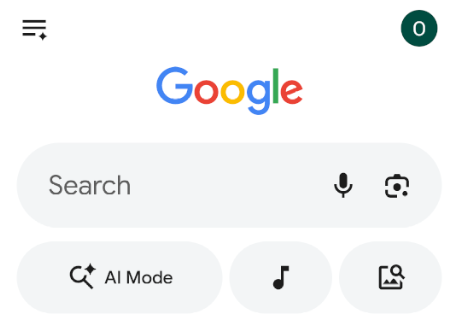
Google's new multimodal search box
The multimodal search box, powered by Gemini 3.5 Flash: an AI Mode button next to the input field.

The ten sub-types fall along two axes: timing (before or while typing) and placement (anchored in the page or floating as an overlay). Click a sub-type.

Before typing

zero-prefix · on-focus
_ZP

While typing

prefix
_PREFIX _FUZZY _COUNTERFACTUAL _CORAL _TRYASKING

Anchored

pinned to context
_ANCHOR_ZP _ANCHOR_PREFIX

Floating

popup overlay
_OVERLAY_PREFIX _OVERLAY_ZP
Click a sub-type to reveal its role.
Show the code
enum SuggestSubtype — foyo.java (AGSA v17.26.24) Diff v17.25.36 → v17.26.24 (forz.java → foyo.java)
AGSA v17.25.36 (forz.java, 3622) vs v17.26.24 (foyo.java, 3656) · jadx · enum SuggestSubtype

Act 2 · Eyes 2

The browser that reads the page

Contextual skills pushed page by page; thirteen context types collected per visited URL. The browser no longer browses, it audits.

For every page visited, Chrome queries a Google service that returns what the page allows: ready-made AI skills, picked by content type. The browser no longer browses, it qualifies.

On stage

"Gemini in Chrome helps you on any page." Whether you read a product page, an article or a video, the side panel offers different actions: summarize, compare, explain, check sizing.

In the code

service d'optimisation Chrome SkillsList : compétences IA contextuelles skill.system_prompt : 2-3 KB / skill poussé par type de page, pas par requête

Skills pushed by page type

The same Gemini bar swaps skills depending on what Google has classified for the URL. Pick a page type.

Product page Article / content Video
Shopping
Buying advice
Weighs specs and recurring complaints to advise buy or no-buy.
Shopping
Summarize reviews
Scans customer reviews to surface praise, complaints and trust level.
Shopping
Sizing help
Infers from reviews whether an item runs small, large or true to size.
Show the code
SkillsList (chrome.breve.cacao.boq.skills.config)
Chrome 146.0.7680.75 · scan 12 URLs (2026-03-18)
Act 3 · Agent 3

The agent wakes up

Dynamo (remote browser) and Bonobo (local automation) run tasks with your credentials. 46 modes in the FeatureMode enum.

Exclusive · decompiled, unannounced

The shift from an assistant that answers to an agent that acts. Google runs two execution architectures in parallel, and maps human intent branch by branch.

Cloud · remote browser

Dynamo

runs on Google virtual machines

A server-side browser drives pages, fills forms and makes purchases. Everything is streamed back to you as screenshots.

DynamoPageViewModel · DynamoImage
Device · local automation

Bonobo

Android accessibility services

Gemini acts inside your apps the way a human finger would, driving the UI through accessibility services.

BonoboSessionForegroundService
↘  ↙
One and the same outcome: a task performed on your behalf, with your credentials.
Extracted consent strings (verbatim)

« it may do things like share your info or make purchases without asking »

« Gemini saves remote browser data, like login details and remote code execution data »

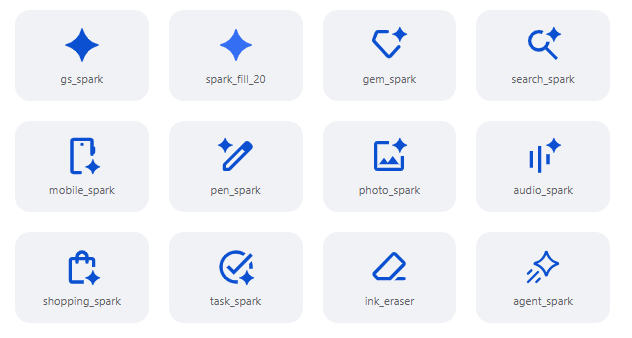
Gemini Spark agent icons extracted from decompilation
The twelve Gemini Spark agent icons, extracted from the decompilation of the Google App.

46 modes in a single enum

The FeatureMode enum exposes 46 modes. Several were never announced; others are opaque codenames with almost no client-side implementation. Hover, click.

Announced Found, unannounced Opaque codename
Click a star to reveal the mode.
Show the code
enum FeatureMode — ezvp.java (AGSA v17.26.24) Execution architectures — classes & services Agent consent — strings.xml (verbatim)
AGSA v17.25.36 / v17.26.24 · jadx · ezvp.java, BonoboSessionForegroundService.java, res/values/strings.xml
Act 4 · Offline 4

On the phone, no network

Gemini Nano V4, on-device function calling, three-tier privacy cascade, AppFunctions: the phone shifts from launcher to intent router.

The phone no longer waits for the network. Gemini Nano V4 can call tools locally: the model no longer just produces text, it acts. The arbitration between device and cloud becomes a privacy cascade.

On stage

Gemini Nano V4: 2 and 4 billion parameters, based on Gemma 4, 140+ languages, native on-device function calling. Android 17 "Aluminium" builds the agent into the system through AppFunctions. The app launcher becomes an intent router: the user no longer opens an app, they state a need and the system decides what runs it.

In the code

on-device model = Gemma 3n blueprint vocab 256128 · hidden 2048 · 35 layers quant a16w8w4 (INT16/INT8/INT4) androidx.appfunctions schema 175 → 346 fichiers (+98%)

The three-tier cascade

Firebase Hybrid Inference arbitrates each intent, default policy PREFER_ON_DEVICE. Click an intent: follow where processing stops, and why.

Summarize an incoming message Fix text as you type Summarize your week from your mail Find the best price on the web
1

On-device — Gemini Nano

0 donnée transmise · 30-50 ms
Local execution in Nano. Content never leaves the phone.
2

Private AI Compute

Titanium TEE enclaves · stateless · no logs
A hardware-encrypted airlock between device and cloud, with no logging.
3

Cloud — Gemini Pro / Ultra

used only when external data is needed
The last resort, when the intent needs information from the world.
Pick an intent to see the arbitration.

The same bet, down to the silicon and beyond Google

Tensor G6 (Pixel 11, fin 2026) : 1+2+4 CPU layout (seven cores instead of eight), older GPU, but an enlarged main TPU and a dedicated nano-TPU for simple AI tasks. Google trades CPU and GPU for neuromorphic silicon.

Siri will be powered by Gemini, a model eight times larger than Apple Intelligence's (150 billion parameters). Project Glenwood, Apple's codename for vendor evaluation, reportedly preferred Google over OpenAI and Anthropic. On Samsung, Nano is licensed for Galaxy AI. The engine becomes the industry's engine.

Related RESONEO study
Tomorrow's AI phone, seen from inside a Google APK

Our mapping of AI moving into the device, based on decoding 274 PCS manifests from the experimental AICore APK: Gemini Nano generations, on-device function calling, the privacy cascade, and the shift from phone to intent router.

Read the full study
Show the code
On-device model extracted (AICore) — Gemma 3n blueprint AppFunctions — agency at the system level
AGSA v17.x · jadx · weights.bin / text_model_conf.json (AICore) · androidx.appfunctions · Firebase Hybrid Inference (SDK public)
Act 5 · Commerce 5

The plumbing of commerce

Four protocols in eighteen months (MCP, A2A, UCP, AP2). When the agent buys, value flows to whoever owns the protocol.

When execution moves from human to agent, value no longer stays with the brand that owns the buy button. It settles with the firm that owns the protocol and the trust primitives.

On stage

Four protocols laid down in under eighteen months. The agent discovers, compares, adds to cart and pays without opening a store. AP2 defines how an agent authorizes a payment on a human's behalf through three cryptographically signed mandates: Intent, Cart, Payment.

In the code

FEATURE_MODE_CHROME_WEB_UNIVERSAL_CART(43) ContentAnnotator : 8 categories panier regles JSON + regex URL · US-first Shopping Graph : 60 Md listings

Four layers around the transaction

Google holds four strategic floors at once. Click a layer.

CatalogShopping Graph
ExecutionAppFunctions
At the centerThe transaction
CartChrome · Universal Cart
PaymentWallet · AP2
Four floors: catalog, execution, cart, payment. Click for detail.

Four protocols in eighteen months

MCP
Anthropic · 2024
Standard grammar by which an agent calls tools.
A2A
Agent2Agent
Communication between agents.
UCP
January 2026 · NRF
Universal Commerce Protocol, launched with Shopify, Etsy, Wayfair, Target, Walmart.
AP2
September 2025 · FIDO
Agent Payments Protocol, 60+ partners (Mastercard, PayPal, Stripe), handed to the FIDO Alliance.
The rally · 24 April 2026

Amazon, Meta, Microsoft, Salesforce and Stripe join the UCP Tech Council. Eight months earlier, Amazon was blocking AI bots and suing Perplexity. Today it sits on the governing body of the standard Google wrote.

Related RESONEO study
How Chrome classifies websites internally

Our decoding of the classification system built into Chrome: how the browser qualifies every page (contextual AI skills, page types, and the eight commerce categories that feed the universal cart) to prepare the agent's action.

Read the full study
Show the code
Chrome universal cart classifier — ContentAnnotator Protocols & trust primitives
Chrome OptimizationGuide (ContentAnnotator, v147+) · AGSA ezvp.java · UCP/AP2 (specs publiques, FIDO Alliance)
Act 6 · Personalization 6

Personalization is the architecture

An on-device ranking score tilted toward the temporal and the personal. There is no longer a reference SERP to observe.

Personalization is no longer an add-on bolted onto ranking. It is the default architecture. The score that orders your results leans toward the temporal, the behavioral and the personal.

On stage

The SERP no longer serves the same result to two people in the same place. On the device, a score sums weighted signals: time of day, home-work commute, interactions over the last 7, 14 and 28 days, card click-rate, a habit-confidence index. The AI Overview is pre-computed while you type.

In the code

score = SUM(weight × value) 57 signal IDs · 39 feature types 18 data sources · tolerance 1.0E-7 PERSONALIZED_CONTEXTUAL (serveur) AppSearch : 10 strategies (0-9)

Fifty-seven signals, and the scale tips

Scroll: the signal bar physically tips toward the personal.

Content relevance, popularity Temporal · Behavioral · Personal

Reranking, on-device and server-side

On-device
Weighted linear sum
Additive score tilted toward temporal and behavioral signals, computed locally.
Server
PERSONALIZED_CONTEXTUAL
Personalized contextual reranking becomes the default architecture, not an option.
Server
LLM_RERANK
A language model reorders results based on the query context.
Server
HOBBES_CONTEXTUAL_RERANK
Contextual reranking system spotted in the code, on the Hobbes side.
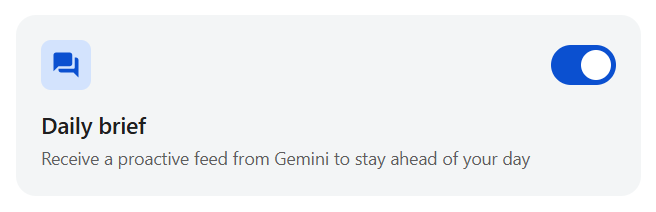
Personal Intelligence Daily Brief
The Personal Intelligence Daily Brief: a proactive feed generated by the agent from your personal graph.
Show the code
On-device scoring — extracted infrastructure Personal Intelligence — persistent personal memory
AGSA / AICore · jadx · C2_APPSEARCH_SCHEMA_DETAILS.md · CHROME_OPTIMIZATIONGUIDE_API_COMPLETE.md
What shifts, what stays

Five levers, and one last stronghold

The technical-content-popularity triad becomes table stakes. The strategic layer moves elsewhere.

1
The brand as an entity
Entity recognition outweighs textual relevance. With no proper node in the Knowledge Graph and no off-site authority, a brand does not exist as a citation candidate.
2
The surfaces models cite
Invest where the models draw from: Reddit, YouTube, Wikipedia, specialist listicles, transcribed podcasts. Citation frequency is built off your own site.
3
Headless commerce
Decouple commerce logic from the visual front and expose it through a UCP-compliant feed. A catalog not exposed to agents is invisible in the cart next door.
4
The erasure of measurement
With personalized SERPs and probabilistic citations, the metric migrates from impression and click to share of citation and parametric visibility, anchored in the models' weights.
5
Exposure by protocol
Expose your capabilities through AppFunctions on Android and an MCP server on the web. It is the equivalent of the 2005 XML sitemap: invisible, yet it decides whether you exist.

Chess is the first territory AI conquered in the eyes of the world. On 11 May 1997, Deep Blue beat Garry Kasparov. Thirty years later, Chess.com has 250 million members and 20 million games played every day. AI did not kill chess; it made it more alive. People do not play for the perfect move, but for the gaze across the board.

The Harvard Study of Adult Development, the longest study ever run on human life (85 years, three generations), reaches a simple conclusion: the best predictor of health at 80 is not income, nor IQ, nor genes. It is the relationships you kept at 50.

If the agent knows, acts and anticipates, one thing remains that no model will ever do: to be someone for someone. In a world where intermediation becomes total, the last inimitable asset is neither content, nor data, nor protocol. It is the relationship.

This infographic shows only the evidence. The full analysis, with its implications for SEO, commerce and the open web, is on Substack.

Read the full analysis on Substack

Other sources and studies

June 2026 3,729,456 Google internal URLs, without opening a single one June 2026 What Google is really building June 2026 Inside Pinterest's algorithm June 2026 How Chrome classifies websites internally May 2026 Tomorrow's AI phone, seen from inside a Google APK May 2026 Ranking of the top Google Preferred Sources Apr 2026 Inside Brave Search: the invisible infrastructure of genAI Apr 2026 How ChatGPT Search works? Full reverse engineering Mar 2026 Reverse-engineering Chrome's hidden AI model: Gemini Nano v3 Mar 2026 TikTok: Inside the world's most addictive algorithm More stuffs...
RESONEO