Chrome extension · July 2026

What Google reads, shows and hides in its AI answers

AIO/AIM/WG Inspector is a Chrome extension that compares, for one query, the organic sources and those of the AI Overview, AI Mode and Web Guide. On Web Guide it rebuilds the full retrieval funnel, checked against the numbers Google itself prints. Everything runs in your browser, with no data sent anywhere.

Powered by RESONEO

Google's generative surfaces no longer stop at AI Overviews and AI Mode: a third one, Web Guide, is being tested in the US and outright replaces the organic list with results grouped and rewritten by an LLM. Web Guide has one property no other surface offers: it prints how many documents it read and how many it kept. This page walks through the three surfaces, what remains observable from the browser, and the extension we built to measure it.

For the historical depth, see our February 2026 deep dive.

Table of contents

1 Web Guide, the surface that shows its pipeline 2 AIO and AIM, the two other surfaces 3 What changed since February 4 The Cross tab: four source sets 5 The signals still worth reading 6 Install and use the extension 7 Technical deep-dive
1

WG Web Guide, the surface that shows its pipeline

The only Google surface that prints its own retrieval funnel.

Launched on July 24, 2025 as a Search Labs experiment, Web Guide replaces the ten blue links with thematic groups: a synthesis paragraph, then results clustered by intent, each rewritten by an LLM. A year later it remains opt-in and US-only (Labs, then the Web tab for enrolled users).

What SEO studies say about it

Google describes a query fan-out: a custom Gemini breaks the query into parallel sub-queries, then groups results by theme (announcement covered by Search Engine Land). At Moz, Dr. Pete Meyers reports that Web Guide results run on FastSearch with the RankEmbed model, the lightweight retrieval described at the DOJ trial. Ahrefs stresses one click-side difference: unlike AI Overviews, which partly suppress clicks, every Web Guide result remains a clickable link.

Access: the Labs experiment (it then fires on some searches), the Web tab, or the nem=10 parameter to force it. A caveat for measurement: forcing nem=10 multiplies the candidate pool by two to four compared with the native mode.

The same retrieval plumbing as AI Mode

This is the central finding of our captures: Web Guide goes through the same retrieval pipeline as AI Mode. Same asynchronous endpoint /async/folwr, same parameter core, same session and auth tokens (garc, lro, mstk), same session thread identifier. At equal budget (native versus native), both surfaces reach into candidate lists of the same order of magnitude, and a third to half of the URLs AI Mode cites sit in the corpus Web Guide read. AI Overviews shares none of that layer.

Above that shared plumbing, everything diverges: of 18 URLs carrying an index on both surfaces, zero share the same rank. AI Mode keeps word-for-word extracts of pages, Web Guide rewrites each document as a third-person summary. One retrieval engine, two consolidations, two reading strategies.

The extension's Web Guide tab

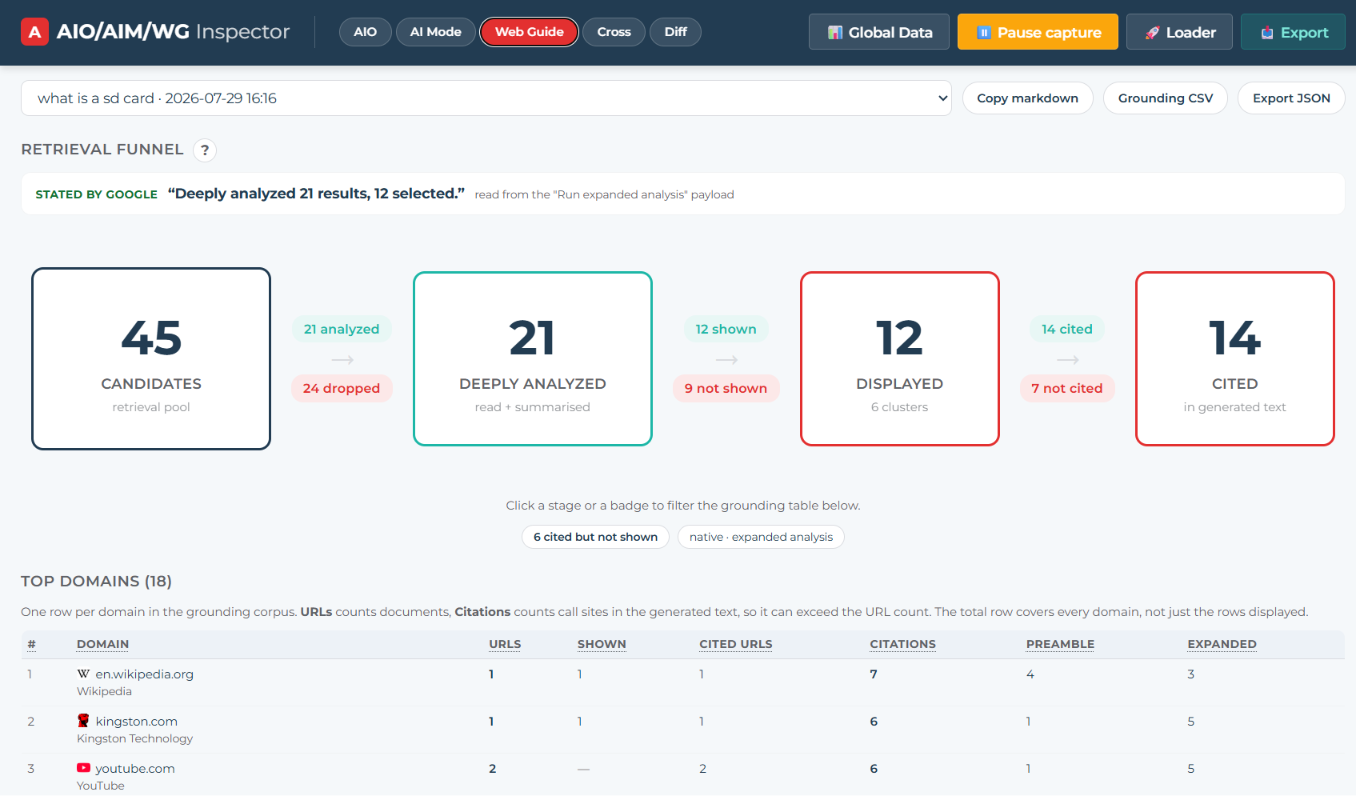
Real capture, query "what is a sd card", July 2026.

The extension's Web Guide tab: retrieval funnel and domain table

The green "stated by Google" banner quotes the sentence Google prints on its page: "Deeply analyzed 21 results, 12 selected".

45
Candidates
retrieval pool
21 analyzed
24 dropped
21
Deeply analyzed
read + summarised
12 shown
9 not shown
12
Displayed
6 clusters
14 cited
7 never cited
14
Cited
in the generated text

How to read this capture

Every document Web Guide reads carries an index number, and the citations in the generated text point at those numbers. That is what makes the funnel measurable document by document, where it had to be inferred on the other surfaces:

  • 45 candidates: the pool size, inferred from the highest index observed. The 24 holes in the numbering are candidates retrieved then discarded before reading; Google exposes neither their URL nor their title, only the missing number.
  • 21 deeply analyzed: the number stated by Google itself. Each of these documents gets an LLM-written summary, which the extension captures.
  • 12 displayed: the visible cards, spread over 6 thematic clusters. Nine read documents are never shown.
  • 14 cited: the documents referenced in the generated text. It exceeds the 12 displayed because the two sets are not nested: here, 6 documents are cited without getting a visible card (the capture's "cited but not shown" filter), sources that wrote the answer without getting any visibility.

The "Top domains" table then aggregates per domain: how many URLs in the corpus, how many shown, how many cited, and how many citation call sites in the text (the Preamble and Expanded columns, depending on whether the citation sits in the synthesis paragraph or in the expanded analysis). The YouTube row is the interesting case: two URLs read, no card displayed, six citations anyway.

Why this matters. Web Guide reads 30 to 166 documents depending on the query and shows only 50 to 60% of them. That invisibility rate is stated by Google itself on the page. For an SEO, being in the read corpus without being shown or cited is a measurable state, and that gap is exactly what the extension puts into a table.
2

AIO and AIM, the two other surfaces

Same engine, two ways of answering, and two sets of sources.

The two historical generative surfaces are still captured by the extension, each with its own tab. Both rely on Google's generation, but they don't sit in the same place and don't follow the same citation logic.

AIO  AI Overview

The generative block that appears at the top of a normal results page, above (or in place of) the blue links. The user asks for nothing special: they type their query, and Google decides to surface a written answer with a few cited sources on the side.

Context: the usual /search page, organic results still present below.

AIM  AI Mode

A conversational mode of its own, reached through the dedicated tab (parameter udm=50). Google builds a longer answer there, often in several parts, with its own citations and a sources column. Follow-up questions can be chained.

Note: these pages have no #rso block, so there are no classic organic results to compare on the page itself.

Three surfaces, three placements. AIO sits on top of organic, AIM lives in its conversational tab, Web Guide replaces organic. For a website, the question is no longer "am I in the top 10" but "does Google read me, show me and cite me", and the answer differs from one surface to the next for the same query.
3

What changed since February

An update on our February 2026 study.

In February, our first version of the plugin reconstructed a three-layer pipeline for AIO, with the full list of grounding URLs. That is no longer possible. Here is what disappeared, what still holds, and where the information moved.

What disappeared: AIO's grounding URLs

The Grounding → Pool → Displayed chain (candidates kept, dropped or injected) is no longer observable in the data sent to the browser: the February version's "AIO pipeline view" relied on fields Google no longer sends. In our July captures, the remaining MAGI URLs match the displayed citations one for one, with no hidden domain. The only injection signal still readable is the video (often YouTube) added to the answer.

What still holds

The capture core still works: the TgQPHd payload markers are now common to all three surfaces (several hundred per capture), and the data-subtree structure that delimits the blocks has not moved. Citations, entities, fragments and sources still extract cleanly. CSS class names keep changing; data-* attributes survive.

Where the hidden corpus went

The large "read but not shown" set has not vanished from Google, it changed surface. Web Guide reads 141 to 166 documents on our forced queries and displays only 69 to 80, a 50 to 60% invisibility rate that Google states itself. What February inferred from scripts, Web Guide prints in plain words: the pipeline view is no longer relevant for AIO, and it became relevant for Web Guide.

Framing consequence: on AIO and AIM, the tool no longer claims to reconstruct Google's internal selection and focuses on who is cited, where, with which signals. On Web Guide, the full funnel is measurable again, and it is checked against the numbers Google prints.

4

The Cross tab: four source sets

Organic, AIO, AIM and Web Guide on the same query.

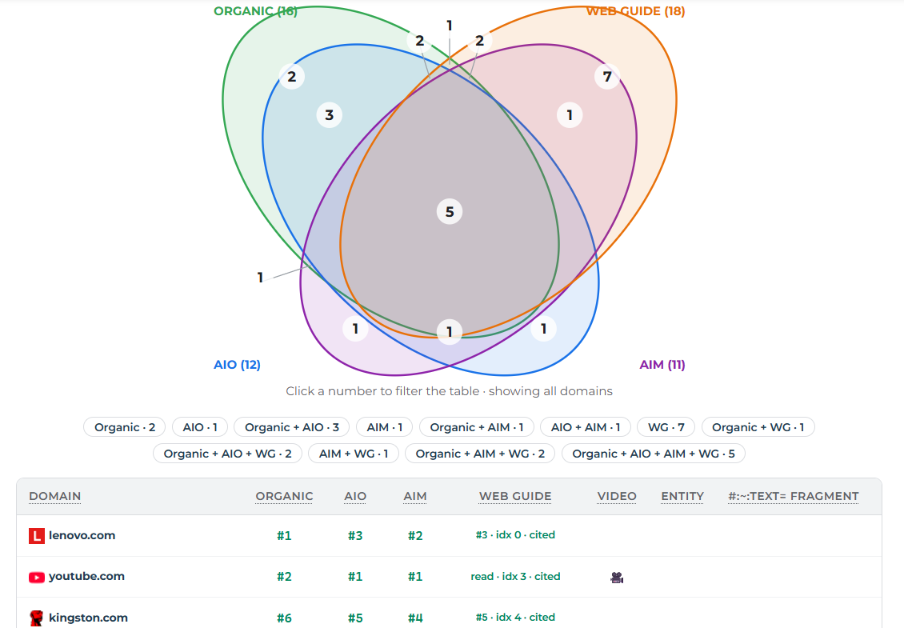
For one query, which domains are visible in organic, in AIO, in AIM, in Web Guide, and which are shared? With four sets, the Venn diagram goes from 7 to 15 non-empty regions. The full overlap remains a minority.

The extension's Cross tab: four-set Venn diagram and per-domain table

Same query as above: organic (16), AIO (12), AIM (11), Web Guide (18). Each chip filters the table.

How to read this capture

On this query, only 5 domains sit in all four sets at once. Web Guide is the largest contributor (18 domains) and keeps 7 to itself: sources no other surface shows. The table below breaks down each domain, one column per surface:

  • lenovo.com: organic #1, cited #3 in AIO, #2 in AIM, and card #3 in Web Guide with corpus index 0, in other words the first document retrieval brought back. A case of full alignment.
  • youtube.com: #1 in AIO and AIM, but on the Web Guide side the "read · idx 3 · cited" label flags a document that was read (index 3) and cited in the text, with no displayed card. The Video column marks the video injection.
  • kingston.com: organic #6, AIO #5, AIM #4, Web Guide card #5 (index 4). The Entity and #:~:text= columns add detected entities and exact citation fragments.

Every Venn region is clickable and filters the table: "WG · 7" isolates, for instance, the domains only Web Guide surfaces. It is the most direct view of what each surface adds to or removes from the classic ranking.

Two limits to keep in mind. AI Mode pages (udm=50) and Web Guide carry no full organic block: the comparison uses the AIO capture of the same query as the organic baseline. And ranks never compare across surfaces: the Web Guide corpus index starts at 0 and behaves like a retrieval rank, the AIO/AIM position is an emission counter that can start at 84. Of 18 URLs indexed on both sides, none carries the same number.
5

The signals still worth reading

Beyond simply "who is cited".

Per-document LLM summaries WG

Every document Web Guide reads gets a model-written summary, and each card also carries the classic title and meta description of the same URL. The before/after comes for free: you see exactly what the LLM rewrite keeps from a page, and it is not a truncation, it is comparative data extracted from the content.

Cited but not shown WG

Documents that feed the generated text without getting a card or a visible link: 3 to 32 per query in our captures. The anchors of those citations also form a list of entities the model itself chose to attribute each claim.

Inline entities AIO AIM

The entities mentioned in the answer text. In AI Overview, entity links often carry no identifier; in AI Mode, Knowledge Graph identifiers appear. Useful to see which entities Google ties a topic to.

Freshness dates AIM WG

Dates attached to sources: absolute on the Web Guide corpus ("Jul 17, 2026"), relative on its cards ("3 months ago"), and visible in AI Mode too. They indicate which freshness Google favours on a query.

Video injection AIO AIM

The last injection type still visible: a video (often YouTube) added to the answer. We flag it separately, because it does not follow the same logic as text citations.

6

Install and use the extension

Everything runs locally, in your browser.

Download the archive, then load the extension in developer mode, in three steps.

Download the .zip

Open the extensions page

In Chrome, go to chrome://extensions and turn on Developer mode (top-right toggle).

Load the unpacked extension

Unzip aio-aim-inspector.zip, click "Load unpacked" and select the unzipped folder.

Run a capture

Search on Google: the extension captures the page's AI Overview, the AI Mode (udm=50) version of the same query, and Web Guide if your account has access to it.

What you get

Web Guide tab

The candidates / read / displayed / cited funnel, Google's own sentence alongside, and the domain table with preamble and expanded-analysis citations.

Multi-query loader

Paste a list of queries, one per line. The extension processes them in the background, one pass per surface per query, then produces a session report.

Cross view and table

The four-set Venn diagram (organic, AIO, AIM, Web Guide) and a per-domain table: per-surface ranks, corpus index, fragment, entity, video.

Diff tab

Compare two dated captures of the same query to see what changed: added or removed citations, rank changes, answer text.

JSON / CSV export

The whole comparison exports to JSON and CSV, Web Guide grounding included, for further processing in your own tools.

100% local

No data is sent to any server, to RESONEO or to a third party. Local storage only; uninstalling erases everything. Minimal permissions: the extension only reads the active Google results page.

Thanks, Vijay. The multi-query loader and the Diff tab owe a lot to Vijay Chauhan, who shared his code with us. Comparing captures taken on different days comes straight from his work.
7

Technical deep-dive

How Google Search's AI answers work under the hood: court testimony, patents, reverse engineering and parsed data.

7.1 From SGE to AI Overviews, to AI Mode, then Web Guide

The integration of generative AI into Google Search follows a phased trajectory, each phase expanding the role of the LLM. The latest one no longer just adds a block: it replaces the organic list.

May 2023
Search Generative Experience (SGE)
Launched at Google I/O as an opt-in Labs experiment, powered by PaLM 2, with a conversational mode. Elizabeth Reid described a system built on "systems we've been refining for decades" with guardrails limiting eligible queries.
May 2024
AI Overviews (AIO)
SGE rebranded and deployed by default in the US at Google I/O 2024, on a custom Gemini variant. The conversational mode goes away: a one-shot summary at the top of the SERP. After the launch errors ("glue on pizza"), Google reworked the triggering logic. Over a billion users by late 2024.
March 2025
AI Mode (AIM)
Launched in Labs, then opened to all US users at Google I/O in May 2025. Conversational, multi-turn, with query fan-out. Extended globally with Gemini 3 Flash in December 2025.
July 2025
Web Guide (WG)
Launched on July 24, 2025 as a Search Labs experiment (opt-in, US): a custom Gemini groups web results into thematic clusters and replaces the organic list. Then reachable from the Web tab for enrolled users, with a progressive extension of covered query types. Google mentions positive feedback, with no commitment to a general rollout.
2026
France rollout
AI Overviews and AI Mode officially reach French queries in the summer of 2026. Web Guide remains US-only and opt-in as we publish.

7.2 Three products, three architectures

The three surfaces share the same Gemini model family and a grounding logic, but diverge on almost everything else. This table reflects what we observe in parsed data and confirmed public sources.

AI OverviewsAI ModeWeb Guide
UX position Block at the top of the standard SERP Dedicated conversational tab (udm=50) Replaces the organic block (nem=10 to force it)
Trigger Automatic, at Google's discretion User-initiated Labs, Web tab, or URL parameter
Conversational No (one-shot) Yes, multi-turn No
Citations Per-card uuid identifiers Per-card uuid identifiers Integer indices into a numbered corpus
Source metadata Title, snippet, favicon, position Same, plus KG entities Title, per-document LLM summary, date
Volume stated by Google None None « Deeply analyzed N results, M selected. »
Organic results Untouched below None Gone, 2 or 3 survive in the shell

On the transport side the boundary sits elsewhere: AI Mode and Web Guide share the same endpoint and session tokens (see section 1), while AI Overviews goes through a separate channel. Same plumbing, different faucets.

7.3 The RAG pipeline and grounding principle

All three surfaces follow a RAG pattern: the model searches first, then generates an answer anchored in the retrieved results. Google Cloud defines grounding as "the ability to connect model output to verifiable sources of information," which "reduces the chances of inventing content." Patent US11769017B1 ("Generative Summaries for Search Results", 2023) describes this pipeline: receive the query, select Search Result Documents, extract snippets, synthesize with an LLM. A notable detail: the system has several candidate generative models and picks one dynamically based on query classification.

"Only use tools to verify and update even known information. Never use your internal knowledge to answer the user's question. Never invent URLs. Use tools."
Leaked internal Gemini grounding instructions, analyzed by Dan Petrovic / DEJAN AI

Dan Petrovic's analysis of this leak showed that Gemini maintains an ordered cache of retrieval results: markers like [6.2] identify the 6th executed sub-query and its 2nd result, a granular index tying each claim to its source. What Web Guide now makes visible client-side points the same way: a numbered corpus, citations pointing at the numbers, and a funnel where every stage can be counted.

In February we documented three layers for AIO: visible sidebar, in-text citations, and grounding URLs hidden in scripts. That third layer is no longer sent to the browser (section 3). The official eligibility rule has not changed: "to be eligible to be shown as a supporting link in AI Overviews or AI Mode, a page must be indexed and eligible to be shown in Google Search with a snippet."

7.4 FastSearch: what the DOJ trial revealed

During the DOJ v. Google antitrust remedies trial (April-May 2025), an internal retrieval system called FastSearch was described under sworn testimony. Paragraph 44 of Judge Mehta's Memorandum Opinion states:

"FastSearch is based on RankEmbed signals and generates abbreviated, ranked web results that a model can use to produce a grounded response. FastSearch delivers results more quickly than Search because it retrieves fewer documents, but the resulting quality is lower than Search's fully ranked web results."
DOJ v. Google, testimony of Elizabeth Reid (Rem. Tr. 3509:23-3511:4)

RankEmbed is a deep-learning system trained on click-and-query data and human quality rater scores, with "strong natural-language understanding." New in 2026: at Moz, Dr. Pete Meyers reports that Web Guide's results run precisely on FastSearch with RankEmbed. That is consistent with our observations, since Web Guide shares its whole transport with AI Mode, but the detail comes from a secondary source and should be weighed as such.

Methodological caveat
FastSearch was described at trial in the context of Gemini grounding broadly. It is not confirmed that AI Overviews and AI Mode use it specifically; Google may also reserve higher-quality retrieval for its own products and serve FastSearch to third-party developers through Vertex AI.

What the trial confirms, whatever the exact pipeline: the grounding retrieval layer operates independently from traditional web ranking. Our data shows it query after query, many AI sources do not appear in organic, and vice versa.

7.5 Query fan-out

Query fan-out is the decomposition of a query into parallel sub-queries to broaden retrieval coverage. Liz Reid defined it at Google I/O 2025: "Search recognizes when a question needs advanced reasoning. It calls on our custom version of Gemini to break the question into different subtopics, and it issues a multitude of queries simultaneously." Google describes the same mechanism for Web Guide in its July 2025 announcement.

What the captures show
The fan-out is entirely server-side, and none of it leaks to the client. Across our 16 captures: a single q= parameter per capture (the user's own), no sub-query field in any payload, and the string "fanout" found in the source code is the name of a CSS animation. The sub-query counts that circulate are not measurable from the browser: treat them as Google's own account, not as extractable data.

The fan-out's indirect footprint remains visible in pool width: 15 to 334 candidates depending on query and mode on Web Guide, against 5 to 15 citations on a classic AI Overview.

7.6 Knowledge Graph and entity enrichment

AI answers are enriched with entity data from several Google knowledge systems:

TypeSourceRole
Knowledge GraphGoogle KGEntity disambiguation, factual anchoring (people, places, concepts)
Shopping GraphGoogle ShoppingProduct entities with price, rating and review counts (decodable from AI Mode payloads)
Maps / PlacesGoogle MapsLocal entities, geographic anchoring
In-text entity linksGoogle SearchClickable terms in AIO text linking to internal searches, no MID exposed

Enrichment varies by surface: AIO sticks to entity links with no identifier, AI Mode exposes real Knowledge Graph MIDs (kgmid=) and also draws from the Shopping Graph and Maps. A constant observation in our captures: not every entity mentioned in the text gets a KG link. The model knows many of them from the grounding text, not from the graph.

7.7 Gemini model progression

Every Gemini version deployed in Search is described by Google as a "custom" variant, fine-tuned for search tasks.

DateProductModelKey change
May 2023SGEPaLM 2 + MUMLaunch
Late 2023SGEGemini 1.0 custom40% latency reduction
May 2024AI OverviewsGemini ~1.5 customPublic US deployment
March 2025AIO + AI ModeGemini 2.0 customAI Mode launch
May 2025AIO + AI ModeGemini 2.5 customGoogle I/O 2025
July 2025Web GuideGemini customThematic clusters in Labs
Nov 2025AIO + AI ModeGemini 3 ProIntelligent routing
Dec 2025AI Mode (global)Gemini 3 FlashDefault for AI Mode
Jan 2026AIO (global)Gemini 3Default for AI Overviews

Since November 2025, Google routes queries between variants: simple questions go to Gemini 3 Flash, harder ones to Gemini 3 Pro. From a parsing standpoint there is no way to detect which model served a given response: no model name appears in network requests, headers or data. The model identifier is entirely server-side.

7.8 Safety and quality layers

Official documentation describes overlapping safety layers: quality raters and red-teaming at training, YMYL filters before generation, SpamBrain and SafeSearch at retrieval, grounding verification after generation. AI Mode adds agentic reinforcement learning (with DeepMind) that rewards statements backed by retrieved sources rather than hallucinated, plus runtime detection of vulnerable situations.

The September 2025 Search Quality Rater Guidelines include AI Overviews evaluation examples for the first time: accuracy, attribution of cited sources, usefulness of the summary.

7.9 The Information Gain patent and diversification

Patent US12013887B2 (granted June 2024) describes an information gain score: a value between 0 and 1 measuring what a document adds relative to what the user already consulted in their session. If active in the AI systems, cited sources should diversify across successive queries on one topic, a logic particularly aligned with AI Mode's multi-turn design and Web Guide's "different angles" clusters.

Whether it runs in production is unconfirmed. But the patent's timing (mid-2024, amid the proliferation of generated content) and its focus on semantic redundancy make it a plausible candidate for filtering result homogenization.

Other sources and studies

July 2026 ChatGPT experiments tracker: what OpenAI tests before rollout July 2026 How your Google phone tracks you to "serve you better" June 2026 3,729,456 Google internal URLs, without opening a single one June 2026 What Google is really building June 2026 Inside Pinterest's algorithm June 2026 How Chrome classifies websites internally May 2026 Tomorrow's AI phone, seen from inside a Google APK May 2026 Ranking of the top Google Preferred Sources Apr 2026 Inside Brave Search: the invisible infrastructure of genAI Apr 2026 How ChatGPT Search works? Full reverse engineering More stuffs...
RESONEO